
Key points summary:
- The challenge: Grid connection queues and adapting older commercial buildings can slow down the shift towards fully electric heating and cooling.
- The solution: In some cases, a hybrid system that involves some electric elements and stopgaps such as gas heating can be the better option.
- The benefit: If your building isn’t immediately ready for electrification, a modern gas heating system will operate efficiently for about 20 years, by which time the grid should be up to scratch and better able to support electric heating.
Working towards energy-efficiency is more important than ever. Increasingly, businesses are implementing net zero strategies and focusing on decarbonisation, which often involves the electrification of their buildings. This means switching from fossil-fuel based energy sources and technologies to new, fully electric equivalents powered by renewable energy.
At Heritage Heating and Cooling, we know that a business’s heating and cooling system needs to be factored in when considering electrification – alongside a few other things.
1. What are the benefits of electrification?
There are many benefits, both environmental and economical, to investing in building electrification.
Improved energy efficiency and lower operational costs
Switching to renewable energy and all-electric technology improves energy efficiency and reduces consumption. This is better for the environment and better for your energy bill too.
Future-proofing and energy security
Energy standards are only likely to get stricter; electrification helps support energy independence and safeguard against future fluctuations in fossil fuel energy prices.
Attracting investment
All-electric buildings are attractive to investors both in the UK and internationally, especially as they comply with the sustainability targets outlined in the European Union’s ESG goals.
2. Is your building ready for electrification?
The reality is, older commercial buildings were not designed with energy efficiency and all-electric power in mind. Before embarking on the larger project of total electrification, it’s a good idea to make sure your building is as ready for it as possible.
Broadly speaking, this means ensuring your building is as efficient and weather-proof as it can be. Adding and improving insulation, fixing and sealing air gaps – all this helps keep the air you are heating or cooling inside your building. This in turn helps fully electric heating and cooling systems run as effectively and efficiently as possible, and will save your business money further down the line.
You could also consider installing:
- Destratification fans: An efficiency-boosting addition to any heating system, these fans recover heat lost in the high ceilings of large commercial buildings, and push it back to floor level.
- Air curtains: Ideal for buildings where large loading bay doors are frequently left open, these fan-powered units are installed over doors and create an air barrier, helping to prevent heated air from escaping.
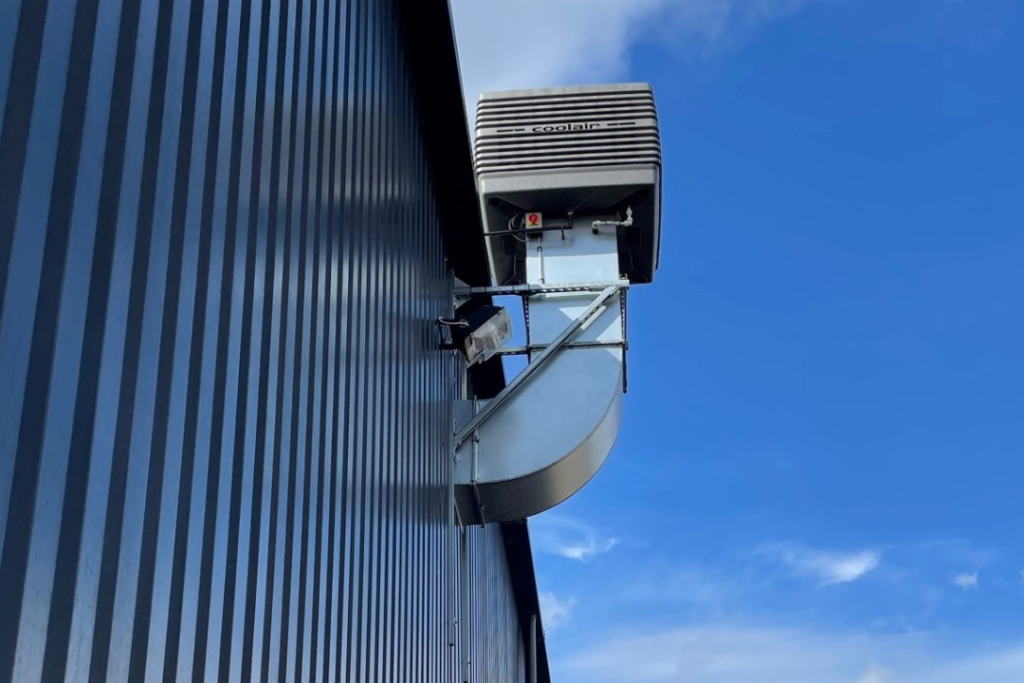
- Evaporative cooling: An ideal cooling solution for businesses working towards decarbonisation, evaporative cooling harnesses the natural processes of evaporation to cool air, and uses up to 90% less electricity than many traditional AC models.
3. Is your grid connection suitable?
As more buildings moved towards electrification, the electrical grid is put under increasing strain. For UK businesses, upgrading their connection to the grid is often the big blocker when it comes to electrification.
Every business is located a certain amount of power, known as kVA (kilo-volt-amperes). Once operating from a fully electrified building, a business will likely need more power, meaning it needs to increase its kVA capacity. However, this isn’t always immediately possible.
Whilst renewable energy generation is growing rapidly, further improvements need to be made to electricity substations and local grids to keep up with increased demand. This results in grid connection queues, with businesses waiting months or even years to upgrade their grid connection enough to support electrification.
4. Should you fully electrify your heating and cooling?
Commercial heating and cooling are two of the main concerns for businesses considering electrification. Heat pumps, for example, have become a very popular and efficient electric heating option. Renowned for delivering up to five times more energy than they consume, heat pumps transfer free outside heat into a building and emit no pollutants into the air.
There are factors to take into consideration when considering electrification:
- Space limitations: Compared to traditional gas boilers, heat pumps need quite a lot of space to accommodate the additional infrastructure that comes with them.
- Temperature limitations: In large commercial spaces, heat pumps can struggle to quickly achieve the high temperatures we’re accustomed to with gas boilers.
- Grid connection: Again, it all comes back to the power available to your business. Before making the switch to a heat pump, it’s important to check that you have enough kVA capacity to cope with the change.
5. Would a hybrid system better suit your needs?
If upgrading to a fully electric system is unfeasible at the moment, a hybrid heating and cooling system could be the perfect stopgap.
For some businesses, gas heating remains a viable investment because they will last for up to 20 years, and modern units are much more efficient than older, fuel hungry models. If grid connection queues and a building that’s not ready for electrification are hindering your plans for electric heating, a modern gas boiler can bridge the gap between now and a future, easier transition to other heating methods.