Finding the perfect warehouse cooling system helps keep things comfortable during the warmer months. For many years, traditional air conditioning (AC) was seen as the go-to cooling solution for warehouses. However, the ErP 90% efficiency rule brings to light AC’s potential to be a financial drain for warehouses – and how evaporative cooling could be the better solution.
The 90% rule
The “90% rule” refers to the minimum level of seasonal efficiency UK and EU Energy-related Products (ErP) need to have to attain an A-rating on the ErP energy label.
An ErP label is a mandatory directive that all UK and EU products that consume energy must adhere to. It sets minimum efficiency and emissions standards for these products, and labels them according to where they score. HVAC appliances – including industrial heating and cooling – fall under these directives.

These familiar, easy-to-read scales rank products from A to G – with A being the most efficient. If an HVAC unit meets or exceeds 90% seasonal efficiency, it earns an A-rating.
Warehouse industrial cooling: Where traditional AC falls short
Traditional high-power refrigerant AC systems are designed to work effectively in sealed, low-ceiling working environments like offices. In huge, high-ceilinged facilities like large-scale warehouses, AC systems have to contend with factors that limit their effectiveness and make them a huge financial drain for businesses.
There are several reasons why traditional AC systems are not the best way to keep warehouses cool.
Massive air volumes and low insulation
Most warehouses are extremely large and constructed primarily using corrugated metal and concrete – which provide poor insulation. Traditional AC has to work incredibly hard to cool huge amounts of air in a badly insulated space, leading to low efficiency and increased running costs.
Open doors
With goods constantly on the move, warehouses are continually opening and shutting large doors. Often, large roller doors are also left open for extended periods during dispatch, causing cool air to escape. AC can’t compensate efficiently for this continual exchange of air, and has to run harder just to maintain a baseline temperature.
High-ceilings and air stratification
Warm air rises and gets trapped in high warehouse ceilings; traditional AC systems struggle to cool this air and distribute it evenly. This causes massive temperature variations across a warehouse and “hot spots” that are difficult to cool down without auxiliary fans – further adding to energy costs.
Why evaporative cooling works so well in warehouses
Evaporative cooling is a low-energy, highly efficient industrial cooling system designed to be effective in large, high-ceilinged spaces such as warehouses and factories. A properly installed and well-maintained evaporative cooling system can operate at only 10% of the cost of traditional air conditioning.
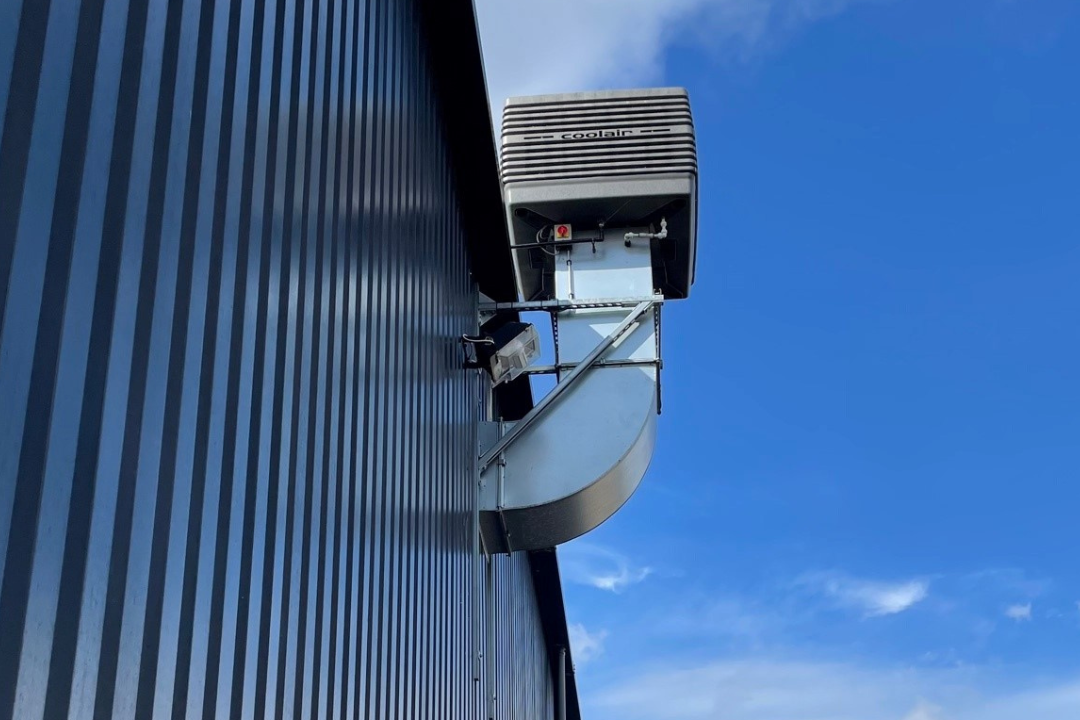
There are several reasons why this cooling solution cooling is increasingly used in large-scale facilities.
1. Energy saving and efficient
Efficient by design, evaporative cooling units use around 90% less energy than traditional, high-powered AC units.
Instead of using chemical refrigerants, evaporative cooling uses the natural cooling produced by water evaporation to rapidly cool air. This natural process means evap cooling systems uses far less energy than refrigerated AC.
This rapidly cooled air is then evenly distributed throughout large buildings using fans, leading to even temperature distribution and reduced energy usage.
2. Maintains efficiency even with doors open
Evaporative cooling systems are constantly drawing in and cooling fresh air from outside. When doors and windows are left open – even large loading bay doors – the cool air that escapes is constantly being replaced.
In the summer, it also means windows and exterior doors can be left open to let in fresh air and stop things getting stuffy.
3. Better air quality
Whilst traditional AC units constantly recycle the same stale air to maintain efficiency, evaporative cooling continually draws in fresh air. This improves the overall air quality of a warehouse and can even reduce the spread of viruses – a huge benefit to people with allergies or respiratory problems.
4. Reduced maintenance costs
Refrigerant AC has to run incredibly hard to keep a warehouse cool, inevitably leading to more wear and tear on internal parts and increased maintenance costs.
Evaporative cooling units have fewer moving parts than AC, making them simpler and much cheaper to maintain. Regular servicing from qualified heating and cooling engineers at Heritage will keep an evap cooling system running efficiently for years to come.